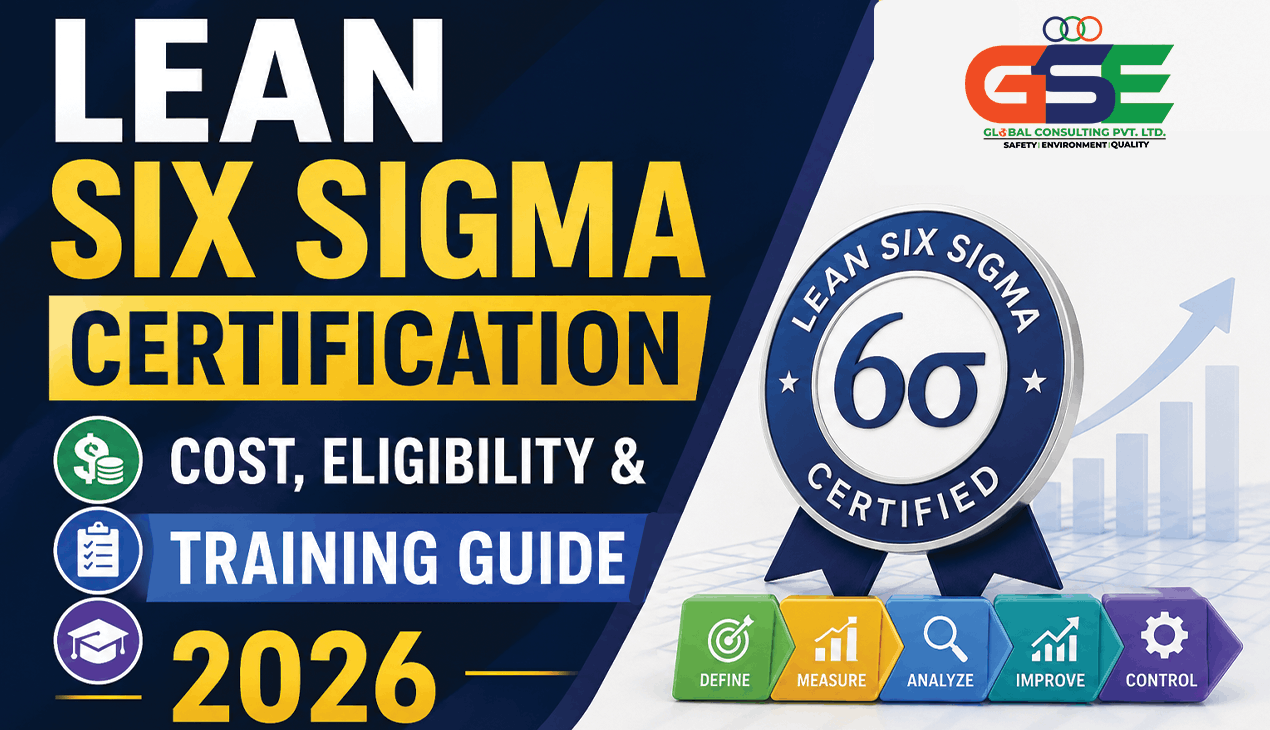
Lean Six Sigma Certification Cost, Eligibility & Training Guide 2026
Lean Six Sigma Certification in 2026 – Complete Guide for Professionals
In today’s competitive business world, companies are continuously searching for professionals who can improve quality, reduce waste, increase efficiency, and deliver better results. One of the most respected qualifications that helps achieve these goals is Lean Six Sigma Certification.
Whether you are a student, engineer, project manager, quality professional, safety officer, operations manager, or business executive, Lean Six Sigma can become a powerful addition to your professional profile.
At Global Consulting for Safety & Environment (GSE), professionals often ask the same questions:
- What is Lean Six Sigma Certification?
- How much does it cost?
- Who can apply?
- Which belt level should I choose?
- Is Lean Six Sigma worth it in 2026?
This complete guide answers everything.
What Is Lean Six Sigma Certification?
Lean Six Sigma is a globally recognized methodology designed to improve business processes by combining two approaches:
Lean
Focuses on eliminating waste and increasing operational efficiency.
Six Sigma
Focuses on reducing defects and improving process quality through data-driven decisions.
Together, Lean Six Sigma helps organizations improve performance while lowering costs.
Today, industries including manufacturing, healthcare, oil & gas, construction, logistics, education, IT, and consulting use Lean Six Sigma principles.
Why Lean Six Sigma Certification Is Important in 2026
Businesses no longer want employees who only complete tasks—they want professionals who solve problems.
Lean Six Sigma certification helps professionals:
✔ Improve decision-making skills
✔ Increase promotion opportunities
✔ Enhance leadership capability
✔ Improve process efficiency
✔ Reduce operational costs
✔ Strengthen international employability
✔ Build analytical and problem-solving skills
Certified professionals are often considered valuable because they can directly contribute to business growth.
Types of Lean Six Sigma Certification Levels
Understanding certification levels helps you select the right pathway.
1. Lean Six Sigma Yellow Belt
Best for:
- Fresh graduates
- Entry-level employees
- Team members
What You Learn:
- Introduction to Lean principles
- Process improvement basics
- Waste reduction concepts
- DMAIC fundamentals
Duration:
1–3 weeks
2. Lean Six Sigma Green Belt
Best for:
- Supervisors
- Engineers
- Project coordinators
- Department managers
What You Learn:
- Advanced process analysis
- Data interpretation
- Root cause analysis
- Process optimization
Duration:
4–8 weeks
3. Lean Six Sigma Black Belt
Best for:
- Senior managers
- Consultants
- Operations leaders
What You Learn:
- Strategic improvement planning
- Leadership and change management
- Statistical analysis
- Business transformation
Duration:
2–4 months
4. Lean Six Sigma Master Black Belt
Best for:
- Corporate leaders
- Training specialists
- Enterprise consultants
Focus:
- Organizational transformation
- Mentoring and governance
Lean Six Sigma Certification Cost in 2026
Certification cost varies from one institute to another. Every training provider sets its own fee based on factors such as:
- Training provider
- Course format
- Country
- Certification level
- Examination method
- Study material and support
- Accreditation and recognition
Because of this, there is no single fixed price for Lean Six Sigma certification.
Approximate pricing may look like this, but the final fee depends on the institute:
Certification Level |
Typical Fee Range |
Notes |
Yellow Belt |
Varies by institute |
Usually the most affordable option |
Green Belt |
Varies by institute |
Depends on training depth and exam support |
Black Belt |
Varies by institute |
Higher cost due to advanced content |
Master Black Belt |
Varies by institute |
Usually the highest fee level |
Some institutes include:
- Training sessions
- Study materials
- Practice exams
- Certification exam
- Digital certificate
At Global Consulting for Safety & Environment (GSE), professionals should compare course outcomes, trainer experience, and practical support—not only pricing.
Lean Six Sigma Eligibility Requirements
One of the biggest advantages of Lean Six Sigma is accessibility.
Yellow Belt
No experience required.
Green Belt
Basic understanding of business processes is recommended.
Black Belt
Professional experience is usually preferred.
Master Black Belt
Advanced experience in improvement projects.
Educational backgrounds that commonly benefit:
- Engineering
- Business Administration
- Safety Management
- Quality Assurance
- Healthcare
- Operations Management
- Supply Chain
- Information Technology
Lean Six Sigma Training: Online vs Classroom
Online Training
Advantages:
- Flexible schedule
- Lower cost
- Learn from anywhere
- Recorded sessions
Best for:
Working professionals.
Classroom Training
Advantages:
- Direct trainer interaction
- Practical workshops
- Networking opportunities
Best for:
Hands-on learners.
How to Choose the Right Lean Six Sigma Institute
Before enrolling, evaluate:
Accreditation
Check whether certification is recognized.
Trainer Experience
Look for industry-based learning.
Practical Projects
Real case studies improve understanding.
Student Support
Availability of guidance after training.
Reviews and Success Stories
Verify learner outcomes.
Professional institutes like Global Consulting for Safety & Environment (GSE) focus on combining training with practical business application.
Career Opportunities After Lean Six Sigma Certification
After certification, professionals commonly work as:
- Process Improvement Specialist
- Quality Manager
- Operations Manager
- Project Coordinator
- Business Analyst
- Continuous Improvement Consultant
- Production Supervisor
- Quality Assurance Lead
Industries hiring Lean Six Sigma professionals continue to expand globally.
Is Lean Six Sigma Certification Worth It in 2026?
For most professionals, yes.
If your goal is to:
- Improve salary potential
- Build leadership capability
- Gain international recognition
- Move into management
- Improve operational skills
then Lean Six Sigma remains one of the strongest professional certifications available.
However, success depends on applying the methods—not simply obtaining the certificate.
Lean Six Sigma Certification is more than a qualification—it is a professional improvement framework.
Choosing the right certification level, understanding costs, and selecting quality training can significantly influence your career growth.
Whether you are beginning your professional journey or moving into leadership, Lean Six Sigma can help develop skills that employers continue to value in 2026 and beyond.
For professionals seeking structured training and industry-oriented learning, Global Consulting for Safety & Environment (GSE) can support development through practical and professional education pathways.
(FAQs)
1. How long does Lean Six Sigma certification take?
It depends on the level. Yellow Belt may take a few weeks, while Black Belt can require several months.
2. What is Yellow Belt in Lean Six Sigma?
Yellow Belt is the beginner level of Lean Six Sigma certification. It introduces the basic concepts of process improvement, waste reduction, and problem-solving. Yellow Belt holders usually support improvement projects and learn how Lean Six Sigma works in simple terms.
3. What is Green Belt in Lean Six Sigma?
Green Belt is the intermediate level of Lean Six Sigma certification. It is designed for professionals who want to take a more active role in improvement projects. Green Belt professionals understand data analysis, root cause analysis, and process improvement methods, and they often lead smaller projects within their department.
4. What is Black Belt in Lean Six Sigma?
Black Belt is the advanced level of Lean Six Sigma certification. It is meant for experienced professionals who lead major improvement projects and guide teams. Black Belt holders have strong knowledge of statistics, process optimization, leadership, and strategic problem-solving.
5. Is online Lean Six Sigma certification valid?
Yes, provided it comes from a recognized training provider.
6. Can Lean Six Sigma increase salary?
Certification may improve opportunities and strengthen career progression.
7. Which industries use Lean Six Sigma?
Manufacturing, healthcare, construction, logistics, IT, education, and consulting.