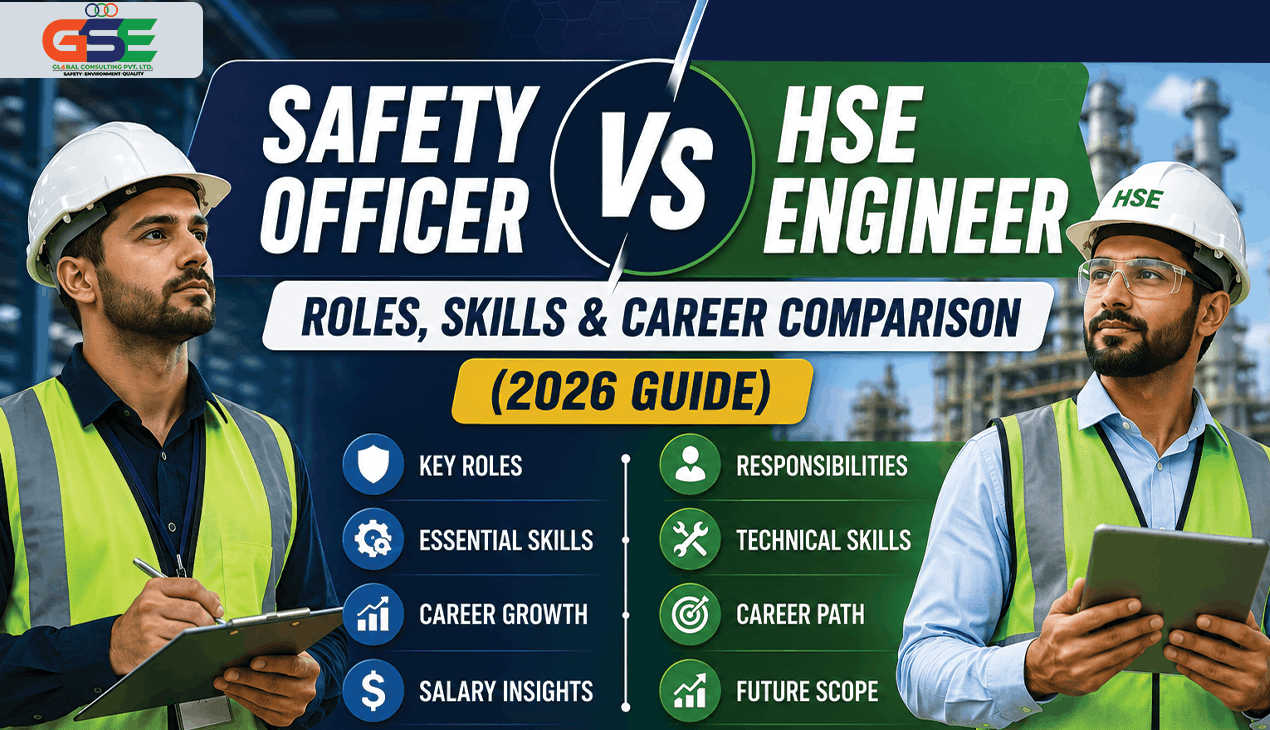
Safety Officer vs HSE Engineer: Roles, Skills & Career Comparison (2026 Guide)
If you’re planning a career in occupational health and safety, one of the most common questions is: should you become a Safety Officer or an HSE Engineer? Both roles are highly respected and offer strong opportunities across construction, oil & gas, manufacturing, logistics, and infrastructure — but they differ in qualifications, scope, and long-term career trajectory.
Whether you’re exploring health and safety courses, planning to enroll in an IOSH Managing Safely Course, or researching professional IOSH training, understanding the difference between these two roles will help you choose the right path. At Global Consulting for Safety and Environment (GSE), we help professionals gain internationally recognized safety qualifications that support career growth across Saudi Arabia, the UAE, Pakistan, and beyond.
This guide compares both roles side by side — responsibilities, qualifications, skills, salary expectations, and career growth — so you can decide with confidence.
Quick Comparison: Safety Officer vs HSE Engineer
Feature |
Safety Officer |
HSE Engineer |
Primary Focus |
Workplace safety |
Health, safety & environment |
Typical Qualification |
Diploma or safety certification |
Engineering degree (preferred) |
Work Location |
Mostly on-site |
Site & office |
Main Responsibility |
Daily safety operations |
HSE planning & management |
Environmental Scope |
Limited |
Extensive |
Risk Assessment Level |
Basic to intermediate |
Advanced |
ISO Management Role |
Supports implementation |
Leads implementation |
Reports To |
Supervisors |
Senior management |
Salary Potential |
High |
Very high |
Both roles share the same mission — safer workplaces — but the scope of responsibility, technical depth, and reporting level differ significantly.
What Is a Safety Officer?
A Safety Officer maintains a safe workplace by identifying hazards, ensuring compliance with safety regulations, conducting inspections, and building a strong safety culture among employees.
Safety Officers work across nearly every industry where workplace risk exists, including:
- Construction
- Oil & Gas
- Manufacturing
- Warehousing
- Logistics
- Healthcare
- Power Plants
Their core objective is simple: prevent accidents and protect employees from injury.
Key Responsibilities of a Safety Officer
- Conducting routine workplace inspections
- Identifying hazards before accidents occur
- Preparing risk assessments
- Delivering toolbox talks
- Monitoring PPE compliance
- Investigating incidents and near misses
- Reporting unsafe conditions
- Conducting safety inductions for new employees
- Ensuring compliance with company safety procedures
- Supporting emergency response activities
Safety Officers spend most of their time on-site, working closely with supervisors, contractors, and workers to maintain a safe working environment.
What Is an HSE Engineer?
An HSE Engineer (Health, Safety, and Environment Engineer) carries broader responsibility than a Safety Officer. Beyond workplace safety, HSE Engineers focus on environmental protection, risk management, legal compliance, sustainability, and continuous improvement of HSE management systems.
HSE Engineers are commonly employed in:
- Oil & Gas Companies
- Petrochemical Plants
- Engineering Firms
- Manufacturing Industries
- Power Generation
- Renewable Energy Projects
- Large Infrastructure Projects
Unlike Safety Officers, HSE Engineers regularly participate in strategic planning and management-level decision-making.
Key Responsibilities of an HSE Engineer
- Designing HSE management systems
- Conducting advanced risk assessments
- Performing environmental impact assessments
- Implementing ISO 45001 management systems
- Managing legal compliance
- Conducting internal HSE audits
- Preparing reports for senior management
- Leading accident investigations
- Developing emergency response plans
- Managing contractor safety performance
These responsibilities demand both technical knowledge and strong leadership skills.
Educational Requirements
Safety Officer
Employers generally look for candidates with:
- Diploma in Occupational Health & Safety
- Relevant safety certifications
- Practical site experience
- Strong communication skills
Professional qualifications such as the IOSH Managing Safely Course, IOSH Training, OSHA courses, and BCSP certifications significantly improve employment opportunities.
HSE Engineer
An HSE Engineer generally requires a bachelor’s degree in one of the following:
- Civil Engineering
- Mechanical Engineering
- Chemical Engineering
- Environmental Engineering
Professional certifications further strengthen an engineer’s profile and improve promotion opportunities.
Essential Skills Compared
Safety Officer Skills
- Hazard Identification
- Workplace Inspection
- Risk Assessment
- Incident Investigation
- Emergency Response
- Communication Skills
- Observation Skills
- Report Writing
- Leadership
- Problem Solving
HSE Engineer Skills
- HSE Management Systems
- Environmental Management
- ISO 45001 Implementation
- Legal Compliance
- Root Cause Analysis
- Data Analysis
- Project Management
- Risk Management
- Leadership
- Technical Reporting
Because HSE Engineers often work directly with senior management, strategic thinking and decision-making are just as important as technical expertise.
Salary Comparison & Earning Potential
Salary varies by experience, certifications, industry, and country — but as a general pattern, HSE Engineers earn more due to their broader technical and managerial responsibilities. Experienced Safety Officers with internationally recognized certifications, however, can still secure highly competitive packages, especially in oil & gas, petrochemical, infrastructure, construction, and energy.
Country |
Safety Officer |
HSE Engineer |
Saudi Arabia |
Higher salaries with experience in construction and oil & gas |
Generally earns more due to engineering responsibilities |
UAE |
Competitive salaries with international companies |
Higher earning potential on engineering projects |
Pakistan |
Good opportunities in construction and manufacturing |
Better salaries for qualified engineers |
Your earning potential ultimately depends on a combination of factors:
- Education
- Experience
- Industry
- Country
- Professional certifications
- Communication skills
- Leadership ability
Career Growth Opportunities
Safety Officer Career Path
Safety Officer → Senior Safety Officer → Safety Supervisor → Safety Manager → HSE Manager
HSE Engineer Career Path
HSE Engineer → Senior HSE Engineer → HSE Manager → Regional HSE Manager → HSE Director
Both paths offer excellent long-term opportunities, especially in industries that prioritize workplace safety and environmental compliance.
Which Career Is Better: Safety Officer or HSE Engineer?
There’s no single right answer — the best choice depends on your education, career goals, and professional experience.
A Safety Officer role is ideal if you:
- Want to start your career quickly
- Prefer working directly on construction or industrial sites
- Enjoy interacting with workers and supervisors
- Are interested in workplace inspections and accident prevention
- Want to build practical HSE experience before moving into management
An HSE Engineer role is a better fit if you:
- Hold an engineering degree
- Enjoy planning and implementing HSE management systems
- Want to work on large industrial or infrastructure projects
- Are interested in environmental management and legal compliance
- Aspire to senior positions such as HSE Manager or HSE Director
Both professions are in high demand across Saudi Arabia, the UAE, Qatar, Oman, Kuwait, and Pakistan.
Best Certifications for Safety Officers and HSE Engineers
Professional certifications play a major role in career development. Employers consistently favor candidates who combine formal education with internationally recognized qualifications, including:
- ASP (Associate Safety Professional)
- CSP (Certified Safety Professional)
- IOSH Managing Safely Course
- IOSH Working Safely
- OSHA Safety Courses
- ISO 45001 Lead Auditor
- ISO 9001 Lead Auditor
- ISO 14001 Lead Auditor
- PMP Certification (for professionals managing projects)
Why Health and Safety Courses Matter
Workplace regulations are constantly evolving, and safety standards continue to get more demanding. Completing professional health and safety courses keeps professionals current with international standards and industry best practices, delivering:
- Better job opportunities
- Higher salary potential
- Improved workplace safety knowledge
- Increased confidence during inspections
- Stronger understanding of international safety standards
- Better promotion prospects
Why Choose an IOSH Managing Safely Course?
The IOSH Managing Safely Course is one of the world’s most recognized safety qualifications for managers, supervisors, and anyone responsible for workplace safety. It covers:
- Hazard identification
- Risk assessment
- Accident prevention
- Legal responsibilities
- Environmental awareness
- Performance monitoring
Completing an IOSH qualification signals a genuine commitment to safe, healthy workplaces — making candidates far more attractive to employers.
How IOSH Training Supports Career Growth
Professional IOSH training delivers practical knowledge that can be applied immediately on the job. After completing it, professionals can:
- Conduct workplace inspections more effectively
- Improve hazard reporting
- Lead safety meetings with confidence
- Support compliance with health and safety legislation
- Build a stronger foundation for advanced certifications such as ASP and CSP
Whether you’re a Safety Officer or an HSE Engineer, IOSH training strengthens your professional profile.
How Global Consulting for Safety and Environment (GSE) Can Help
Choosing the right training provider matters as much as choosing the right certification. GSE offers professional guidance and internationally recognized training designed to raise workplace safety standards for individuals and organizations alike, including:
- Professional health and safety courses
- IOSH Managing Safely Course
- IOSH Training
- ASP Certification preparation
- CSP Certification guidance
- ISO Lead Auditor training
- PMP Certification training
- Corporate HSE training solutions
With experienced instructors and practical learning methods, GSE helps professionals build the knowledge and confidence needed to succeed in today’s competitive job market.
Final Comparison at a Glance
Category |
Safety Officer |
HSE Engineer |
Entry Level |
Easier |
Requires engineering background |
Technical Knowledge |
Medium |
High |
Site Presence |
High |
Medium |
Management Responsibility |
Medium |
High |
Environmental Responsibilities |
Low |
High |
Career Growth |
Excellent |
Excellent |
Salary Potential |
High |
Very high |
Both Safety Officers and HSE Engineers play an essential role in protecting people, property, and the environment. Safety Officers focus primarily on implementing workplace safety procedures and preventing accidents, while HSE Engineers take a broader approach — integrating health, safety, and environmental management into organizational operations.
If you’re beginning your career, becoming a Safety Officer builds valuable practical experience. If you already hold an engineering background and want to move into leadership, becoming an HSE Engineer may offer greater long-term opportunity.
Whichever path you choose, investing in professional health and safety courses, completing an IOSH Managing Safely Course, pursuing IOSH training, and earning internationally recognized certifications will significantly improve your career prospects.
At Global Consulting for Safety and Environment (GSE), we’re committed to helping professionals reach their career goals through high-quality training, expert guidance, and internationally recognized certification programs.
Ready to take the next step? Contact GSE today to find the right course for your career path — Safety Officer or HSE Engineer.
(FAQs)
1. What is the difference between a Safety Officer and an HSE Engineer?
A Safety Officer focuses mainly on workplace safety, inspections, and accident prevention, while an HSE Engineer manages health, safety, environmental compliance, and HSE management systems.
2. Which career offers a higher salary?
HSE Engineers generally earn higher salaries due to their engineering qualifications and broader responsibilities. Experienced Safety Officers with professional certifications can, however, also earn competitive salaries.
3. Is an engineering degree required to become an HSE Engineer?
Yes. Most employers prefer candidates with a bachelor’s degree in Civil, Mechanical, Chemical, Environmental, or another engineering discipline.
4. Can I become a Safety Officer without an engineering degree?
Yes. Many Safety Officers begin their careers with a diploma, relevant experience, and professional safety certifications.
5. Why is the IOSH Managing Safely Course important?
It helps professionals understand workplace hazards, risk assessment, legal responsibilities, and accident prevention — making it a valuable qualification for career growth.
6. Is HSE Engineering a good career in 2026?
Yes. Growing health, safety, and environmental regulations have increased demand for qualified HSE Engineers worldwide, particularly across the Middle East.
7. Are Safety Officers in demand in Saudi Arabia?
Yes. Construction, oil & gas, manufacturing, logistics, and infrastructure projects continue to create strong demand for qualified Safety Officers and HSE professionals.
8. Where can I get professional health and safety training?
Global Consulting for Safety and Environment (GSE) provides professional health and safety courses, IOSH training, ASP preparation, ISO Lead Auditor programs, and other internationally recognized training to help individuals advance their careers.
9. Why should I choose Global Consulting for Safety and Environment (GSE)?
GSE provides professional health and safety courses, the IOSH Managing Safely Course, IOSH training, ASP preparation, ISO Lead Auditor training, and expert guidance to help professionals build successful careers.