Workplace health and safety should be a priority for every organisation. Whether a company operates in construction, manufacturing, oil and gas, healthcare, or another industry, it must take proper steps to protect employees and prevent workplace accidents. A strong health and safety management system helps businesses control risks, improve working conditions, and meet relevant safety requirements.
ISO 45001 is an international standard that provides a framework for managing occupational health and safety. It helps organisations identify workplace hazards, control risks, and improve their safety performance. However, implementing the standard is only one part of the process. Companies must also prepare for an external audit to demonstrate that their management system meets the required standards.
Preparing for an ISO 45001 audit requires proper planning, employee training, accurate documentation, and regular workplace inspections. In this guide, we will explain how businesses can prepare for an ISO 45001 certification audit and improve their chances of achieving certification.
What Is an ISO 45001 Certification Audit?
An ISO 45001 certification audit is an independent assessment of an organisation’s Occupational Health and Safety Management System (OHSMS). It checks whether the company has established and implemented a management system that meets the requirements of ISO 45001:2018.
During the audit, auditors review company documents, interview employees, inspect workplace conditions, and check whether safety procedures are being followed.
The main purpose of an ISO 45001 audit is to confirm that the organisation has an effective system for identifying hazards, controlling workplace risks, and improving employee safety.
The audit also helps businesses identify weaknesses in their existing safety practices and take corrective actions before problems become serious.
Why Is ISO 45001 Audit Preparation Important?
Proper preparation makes the certification process easier and helps organisations identify problems before the external auditor arrives.
Without sufficient preparation, companies may face audit findings due to missing documents, incomplete risk assessments, poor employee awareness, or procedures that are not followed in daily operations.
Here are some important benefits of preparing for an ISO 45001 certification audit:
- Improved Workplace Safety: Helps identify hazards and control risks before they cause injuries or accidents.
- Better Documentation: Ensures that safety policies, procedures, training records, and inspection reports are properly maintained.
- Employee Awareness: Helps employees understand their safety responsibilities and workplace procedures.
- Reduced Audit Findings: Identifies weaknesses before the certification audit takes place.
- Legal Compliance: Helps organisations identify and meet applicable occupational health and safety requirements.
- Stronger Management System: Improves the effectiveness of workplace safety processes.
Businesses in Pakistan, UAE, Saudi Arabia, Qatar, and other Gulf countries can benefit from proper audit preparation, particularly when working with clients that require recognised safety management systems.
1. Understand the ISO 45001 Requirements
The first step in preparing for an ISO 45001 certification audit is understanding the requirements of the standard.
ISO 45001:2018 contains ten clauses, with Clauses 4 to 10 covering the main requirements of the occupational health and safety management system.
These include:
- Understanding the organisation and its context.
- Leadership and worker participation.
- Planning and risk assessment.
- Support and employee training.
- Operational control and emergency preparedness.
- Performance evaluation.
- Internal audits and management reviews.
- Continual improvement.
Management and relevant employees should understand how these requirements apply to their workplace activities.
For example, a construction company must identify risks related to working at heights, electrical equipment, heavy machinery, and falling objects. A manufacturing company may need to focus on machine safety, chemical exposure, and noise control.
Understanding the standard helps organisations identify what auditors will review during the certification process.
2. Conduct an Initial Gap Analysis
Before arranging an external audit, companies should review their existing health and safety management systems.
A gap analysis compares current workplace practices with ISO 45001 requirements. It helps organisations identify missing documents, weak procedures, and areas that need improvement.
During this process, businesses should review their safety policies, risk assessments, employee training records, emergency procedures, and incident reports.
For example, if a company has a safety policy but employees do not understand it, the organisation needs to improve its communication and awareness activities.
Similarly, if workplace risk assessments are outdated, they should be reviewed and updated according to current working conditions.
A gap analysis provides a clear picture of the organisation’s readiness and helps management prepare an effective improvement plan.
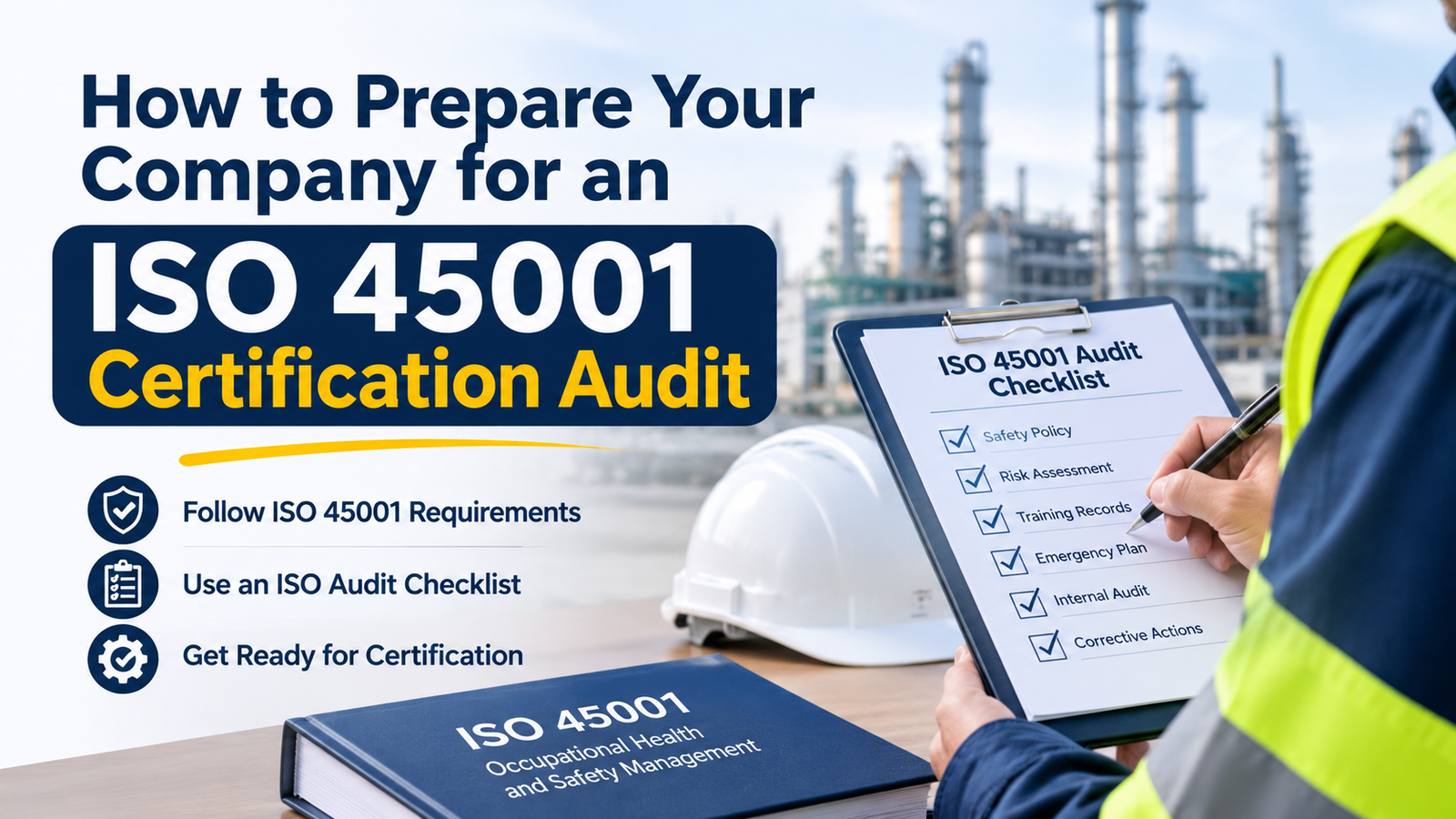
3. Prepare an ISO Audit Checklist
An ISO audit checklist is a useful tool for checking whether all important requirements have been addressed before the certification audit.
It helps organisations review their documents, safety procedures, workplace conditions, and employee awareness.
A basic ISO audit checklist for ISO 45001 should include:
- Occupational health and safety policy.
- Identification of workplace hazards.
- Risk assessments and risk control measures.
- Applicable legal and regulatory requirements.
- Employee training and competency records.
- Roles and responsibilities of employees.
- Workplace inspection records.
- Emergency preparedness and response plans.
- Incident investigation reports.
- Internal audit records.
- Management review records.
- Corrective action reports.
The checklist should be based on the organisation’s activities and relevant ISO 45001 requirements.
Companies should not simply prepare documents to show auditors. They must ensure that the documented procedures are actually implemented in daily operations.
4. Review Workplace Risk Assessments
Hazard identification and risk assessment are important parts of ISO 45001. Organisations must identify potential hazards, evaluate associated risks, and establish suitable control measures.
Before an external safety audit, companies should review their existing risk assessments to make sure they are accurate and up to date.
Common workplace hazards include:
- Slippery floors and unsafe walkways.
- Electrical equipment and exposed wires.
- Working at heights.
- Chemical substances.
- Fire and explosion risks.
- Heavy machinery.
- Poor ventilation.
- Manual handling activities.
For each identified hazard, the organisation should assess the level of risk and decide how it will be controlled.
Companies should also apply the hierarchy of controls when selecting risk control measures. This includes elimination, substitution, engineering controls, administrative controls, and personal protective equipment.
Updated risk assessments show that the organisation actively manages workplace risks rather than relying only on written safety policies.
5. Train Employees and Improve Safety Awareness
Employee awareness is an important part of audit preparation. Auditors may interview workers to check whether they understand workplace hazards, safety procedures, and their responsibilities.
Companies should provide appropriate health and safety training according to employee roles and workplace risks.
Training may cover:
- Workplace hazard identification.
- Proper use of personal protective equipment.
- Emergency response procedures.
- Fire safety.
- Safe equipment operation.
- Incident reporting.
- Workplace risk control.
Supervisors and managers should also understand their responsibilities in maintaining the occupational health and safety management system.
Employees should know how to report unsafe conditions and who to contact when they identify a workplace hazard.
Training records should be maintained as evidence of employee competence and awareness.
6. Conduct an ISO 45001 Internal Audit
An ISO 45001 internal audit is one of the most important activities before the external certification audit.
It helps organisations check whether their management system meets ISO 45001 requirements and whether safety procedures are being followed effectively.
Internal auditors should review relevant documents, interview employees, inspect workplace conditions, and collect evidence.
They should identify nonconformities and record areas where improvements are required.
For example, an internal audit may identify missing employee training records, incomplete risk assessments, or a lack of emergency drill documentation.
These findings should be reported to management, and suitable corrective actions should be taken.
The internal audit should be conducted by competent auditors who can perform an objective and impartial assessment.
7. Review Emergency Preparedness Procedures
Every organisation should have suitable arrangements for responding to workplace emergencies.
Before an ISO 45001 audit, businesses should review their emergency response plans and check whether employees understand what to do during an emergency.
Possible emergencies include fires, chemical spills, equipment failures, explosions, and medical incidents.
Companies should check that emergency exits are accessible, fire extinguishers are available, first-aid arrangements are suitable, and emergency contact information is up to date.
Emergency drills should be conducted where appropriate, and their results should be recorded.
These arrangements help demonstrate that the organisation is prepared to respond to unexpected workplace situations.
8. Prepare for the External Certification Audit
Once the organisation has addressed identified gaps and completed its internal audit, it can prepare for the external certification audit.
The certification process generally involves two stages.
Stage 1 Audit: The auditor reviews the organisation’s documented management system, checks its readiness, and evaluates whether it is prepared for the next stage.
Stage 2 Audit: The auditor evaluates how effectively the management system has been implemented. This includes reviewing records, interviewing employees, inspecting workplace activities, and checking compliance with ISO 45001 requirements.
If nonconformities are identified, the organisation must address them through appropriate corrective actions. Certification is granted by the certification body after the audit requirements have been satisfactorily met.
Companies should select a competent certification body with appropriate accreditation and recognition for their needs.
Common Mistakes to Avoid During an ISO 45001 Audit
Even organisations with established safety systems can face problems during certification audits. Some common mistakes include:
- Using outdated safety policies and procedures.
- Maintaining incomplete risk assessment records.
- Providing insufficient employee training.
- Ignoring previous workplace incidents.
- Failing to conduct regular internal audits.
- Not completing corrective actions.
- Preparing documents only for the auditor without implementing them in practice.
Avoiding these mistakes helps businesses maintain a more effective safety management system and improve audit readiness.
Frequently Asked Questions (FAQs)
What documents are required for an ISO 45001 audit?
Important documented information may include the occupational health and safety policy, risk assessments, legal requirements, training records, incident reports, internal audit results, management review records, and corrective action reports. The exact documentation depends on the organisation’s activities and risks.
How long does an ISO 45001 certification audit take?
The audit duration depends on the organisation’s size, number of employees, locations, activities, and operational risks. Certification bodies determine the required audit time according to applicable audit rules.
What happens if a company fails an ISO 45001 audit?
If auditors identify nonconformities, the organisation must investigate the issues, implement corrective actions, and provide suitable evidence. Certification depends on successfully addressing the applicable audit findings.
Is an ISO 45001 internal audit mandatory?
Yes. Organisations implementing ISO 45001 must conduct internal audits at planned intervals to evaluate whether their occupational health and safety management system meets the standard’s requirements and is effectively maintained.
Who can conduct an ISO 45001 certification audit?
An external certification audit must be conducted by an independent certification body. Internal audits can be performed by competent internal auditors or qualified external professionals, provided impartiality is maintained.
Get Professional Support for Your ISO 45001 Audit Preparation
Preparing for an ISO 45001 certification audit requires more than collecting documents. Businesses must establish effective safety procedures, train employees, review workplace risks, and make sure their management systems work in daily operations.
A well-prepared organisation can identify weaknesses early, improve workplace safety, and move towards certification with greater confidence.
At Global Consulting International, we offer professional ISO training and qualification programs to help individuals and organisations develop their knowledge of international management system standards.
Whether you want to improve your internal auditing skills or strengthen your understanding of occupational health and safety management, our training opportunities can support your professional development.
Ready to take your workplace safety management to the next level? Contact Global Consulting International today to explore our ISO 45001 Lead Auditor training and prepare yourself to build safer, more compliant, and professionally managed workplaces!